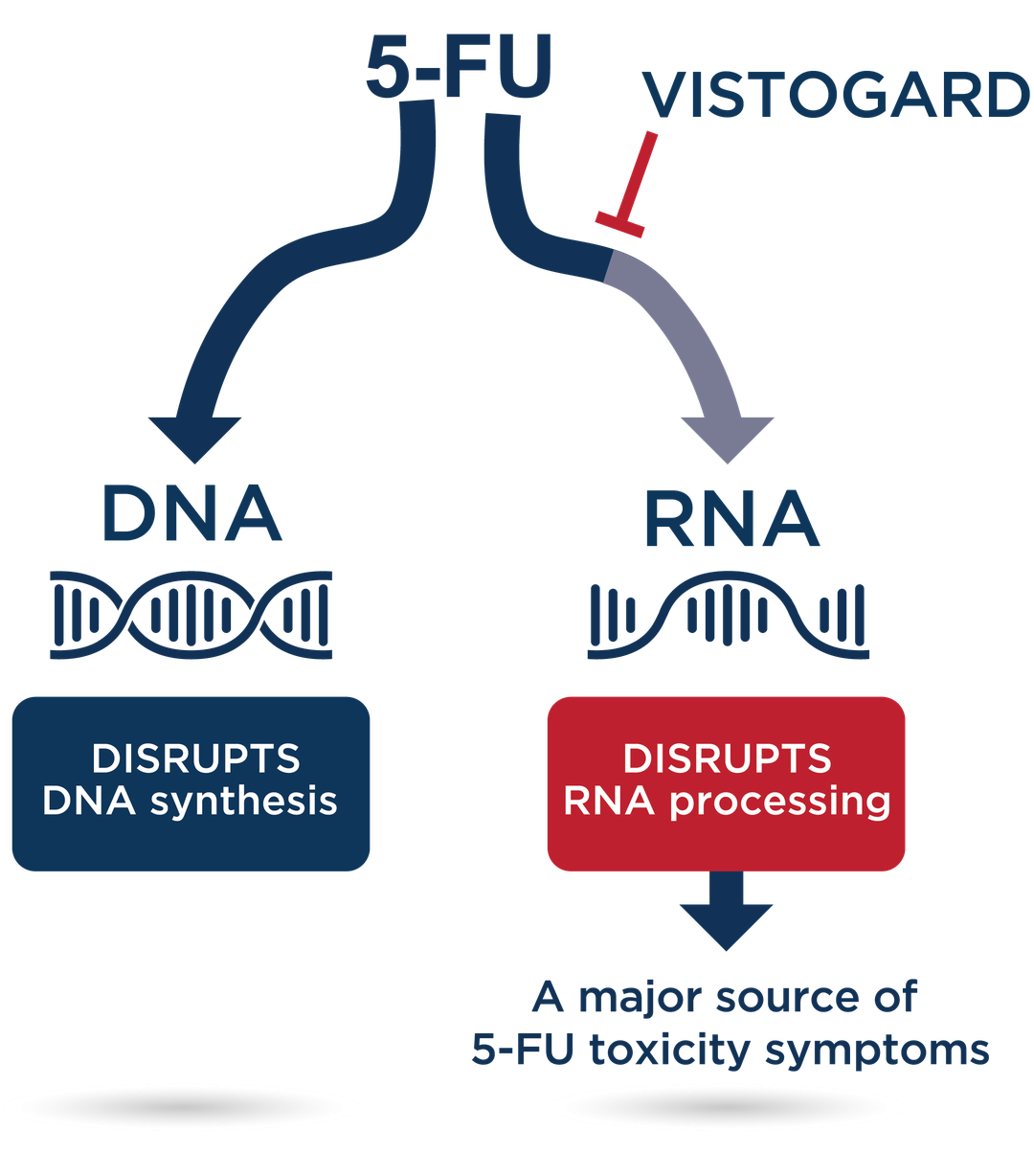
VISTOGARD® (uridine triacetate) Mechanism of action
VISTOGARD increases circulating uridine leading to competition with
fluorouracil metabolites for incorporation into RNA, a pathway associated with fluorouracil
cytotoxicity1,6
Following oral administration, VISTOGARD yields uridine in circulation. Uridine
competitively inhibits cell damage and cell death caused by 5-FU1
5-FU interferes with nucleic acid metabolism (DNA and RNA) in normal and cancer cells. Cells
anabolize 5-FU to the cytotoxic intermediates FdUMP and FUTP1
FdUMP inhibits the synthesis of thymidine, which is required for DNA replication and repair.
Uridine is not found in DNA1
The incorporation of FUTP into RNA is a major source of 5-FU cytotoxicity. Excess circulating
uridine derived from VISTOGARD is converted into UTP, which competes with FUTP for
incorporation into RNA1
VISTOGARD inhibits incorporation of FUTP into RNA, a major source of 5-FU
toxicity1
Animal and in vitro studies have demonstrated that uridine does not interfere with 5-FU
disruption of DNA synthesis; however, this has not been established in clinical
trials11,12
Limitations of use: VISTOGARD is not recommended for the non-emergent treatment of adverse
reactions associated with fluorouracil or capecitabine because it may diminish the efficacy of
these drugs1
The safety and efficacy of VISTOGARD initiated more than 96 hours following the end of
fluorouracil or capecitabine administration have not been established1
Ma WW, Saif MW, El-Rayes, BF et al (2017), Emergency Use of
Uridine Triacetate for the Prevention and Treatment of Life-Threatening
5-Fluorouracil and Capecitabine Toxicity. Cancer 123(2):345-356
Ison G et al. (2016), FDA approval: Uridine triacetate for the treatment
ofpatients following fluorouracil or capecitabine overdose or exhibiting
early-onset severe toxicides following administration of these drugs. Clin
Cancer Res 22(18): 1-5
Brutcher E et al. (2018) Assessment and Treatment of Uncommon, Early-
onset, Severe Toxicides Associated With 5-Fluorouracil and
Capecitabine. Clin J Oncology Nursing 22 (6): 627-634
Polk A. et al. (2016). Incidence and risk factors for capecitabine-induced
symptomatic cardiotoxicity: A retrospective study o f452 consecutive
patients with metastatic breast cancer. BMJ Open, 6, e012798
Genentech, Inc. (2016). Xeloda® (capecitabine) Package Insert
Meulendijks, D et al. (2016) Renal function, body surface area, and age
are associated with risk of early-onset fluoropyrimidine-associated
oxicity in patients treated with capecitabine-based anticancer regimens
in daily clinical care. European Journal of Cancer, 54, 120-130
Froehlich TK et al. (2015). Clinical importance of risk variants in the
dihydropyrimidine dehydrogenase gene for the prediction of early-onset
fluoropyrimidine toxicity. International Journal of Cancer, 136, 730-739
Mitani S et al. (2017) Acute hyperammonemic encephalopathy after
fluoropyrimidine-based chemotherapy: A case series and review of the
literature Medicine 96:22(e6874)
Etienne-Grimaldi M-C et al. (2017) New advances in DPYD genotype
and risk of severe toxicity under capecitabine. PLOS ONE, 12, e0175998
Hamzic S et al. (2018) Come a long way, still a ways to go: from
predicting and preventing fluoropyrimidine toxicity to increased
efficacy? Pharmacogenomics 19(8):689-692 Published Online: 22 May
2018
Rodriguez RU. Public teleconference regarding licensing and
collaborative research opportunities for: methods and compositions
relating to detecting dihydropyrimidine dehydrogenase (DPD). Fed
Regist. 2008; 73(129):38233
Andre T et al. (2004) Oxaliplatin, fluorouracil, and leucovorin as
adjuvant treatment for colon cancer N Engl J Med. 2004;350: 2343-2351
Sara JD et al. (2018) 5-fluorouracil and cardiotoxicity: a review
Therapeutic Advances in Medical Oncology Vol 10: 1-18
Peng J et al. (2018) Cardiotoxicity of 5-fluorouracil and capecitabine in
Chinese patients: a prospective study Cancer Communications; 38(22):
1-7
Yeh KH and Cheng AL (1997) High-dose 5-fluorouracil infusional
herapy is associated with hyperammonaemia, lactic acidosis and
encephalopathy Brit. J Cancer 75(3): 464-465
Cordier P-Y et al. (2011). 5-FU-induced neurotoxicity in cancer patients
with profound DPD deficiency syndrome: A report of two cases. Cancer
Chemotherapy and Pharmacology, 68, 823-826
BTG International Inc. (2023) Vistogard (uridine triacetate) Oral Granules Package Insert
Garcia R et al. (2018) Prompt treatment with uridine triacetate improves
survival and reduces toxicity due to fluorouracil and capecitabine
overdose or dihydropyrimidine dehydrogenase deficiency Toxicology
and Applied Pharmacology 353 (2018) 67-73
Baldeo C et al. (2018) Uridine triacetate for severe 5-fluorouracil
toxicity in a patient with thymidylate synthase gene variation: Potential
pharmacogenomic implications (Case Report). SAGE Open Medical
Case Reports Volume 6: 1-4
Vaudo CE et al. (2016) Early-Onset 5-Fluorouracil Toxicity in a Patient
Negative for Dihydropyrimidine Dehydrogenase Mutations: The Clinical
Course of Reversal with Uridine Triacetate. Pharmacotherapy 36(11)
e178-e182
Santos C et al. (2017) The successful treatment of 5-fluorouracil (5-FU)
overdose in a patient with malignancy and HIV/AIDS with uridine
triacetate. American Journal of Emergency Medicine 35(5) 802.e7-
802.e8
Chu E (2014) Epidemiology and natural history of central venous access
device use and infusion pump function in the NO16966 trial Brit J Cancer
110, 1438-1445 doi: 10.1038/bjc
You are now leaving the patient site.
The section you selected contains information intended for U.S. healthcare professionals only.
Please certify that you are a U.S. healthcare professional by clicking the link below.